
How Retail Chains Can Turn Existing Stores into Local Fulfilment Hubs
Discover how retail chains can turn existing stores into local fulfilment hubs, coordinate online orders and test quick commerce before investing in dedicated dark stores.
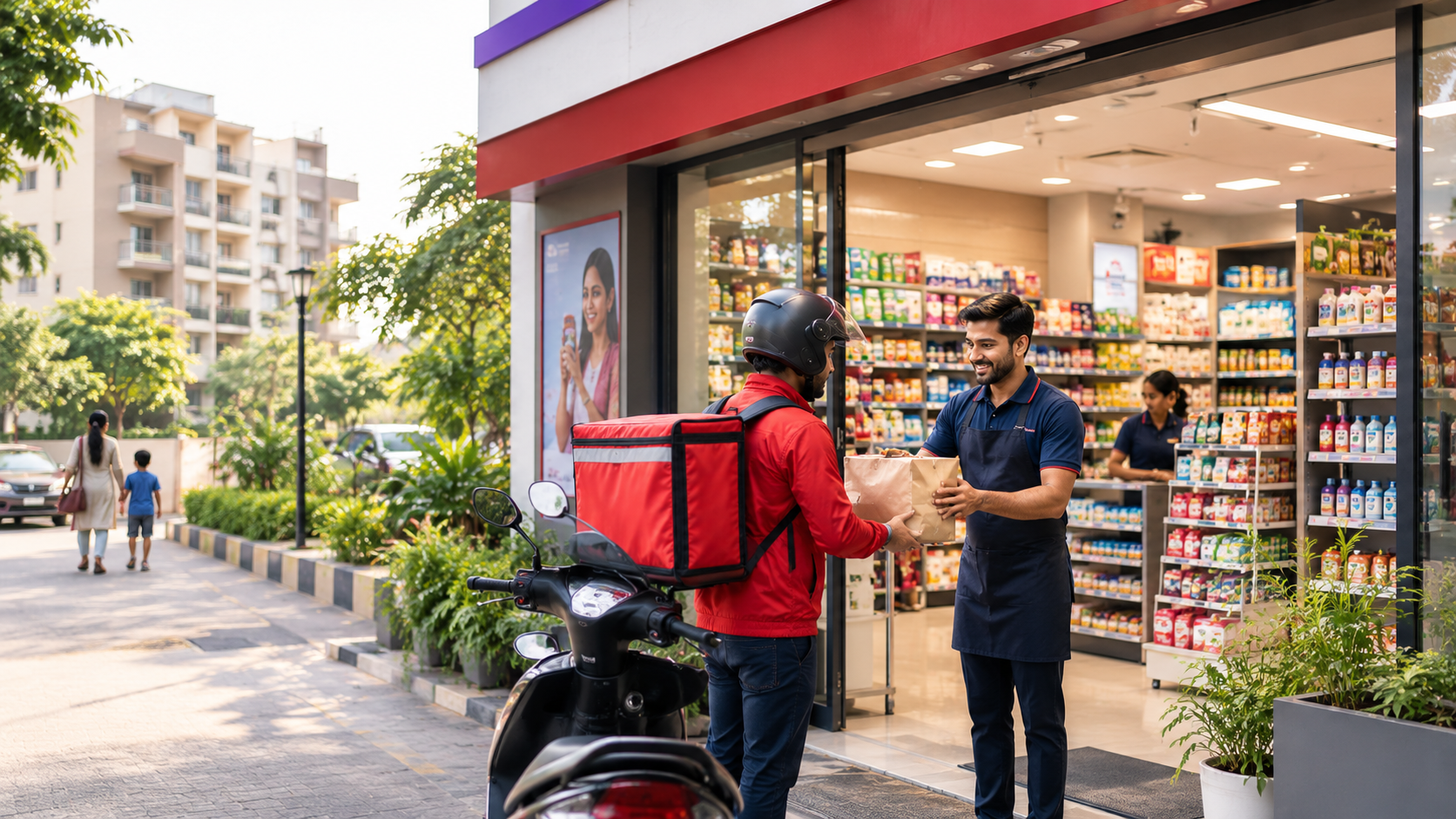
An operational playbook for launching home delivery and quick commerce across existing retail locations—without automatically investing in a separate dark-store network.
In brief
If your retail chain already operates multiple stores close to your target customers, you may be able to launch local delivery using your existing locations instead of opening dedicated dark stores first.
The model is straightforward: accept digital orders, check product availability, route each order to a suitable store, prepare it for dispatch and coordinate delivery.
The challenge is making those steps work consistently across locations that were originally designed for walk-in customers.
This guide explains how to assess your store network, set up the operating workflow and run a focused pilot before deciding whether to expand.
Who this is for: Founders, promoters and operations leaders of regional retail chains with multiple locations across categories such as pharmacy, grocery, fresh food, pet supplies, bakery, beauty, electronics and speciality retail.
If you're starting a new delivery business without your own stores, the supplier-powered commerce model is a different approach and deserves a separate guide.
1. Your stores may already be your fulfilment network
Consider a regional retailer with eight branches across a city.
Each branch holds inventory, serves local customers and has staff who understand the products. Customers may already call individual stores or message staff to ask about availability and arrange delivery.
But these orders often remain disconnected from the retailer's central operations.
One branch records orders in a notebook. Another accepts requests through a manager's personal WhatsApp account. A third handles delivery informally. The central team may have little visibility into order volumes, stock discrepancies, delivery performance or repeat purchases.
The retailer has physical infrastructure, but it lacks a coordinated way to turn that infrastructure into a digital fulfilment network.
That distinction matters.
Opening a store does not automatically make it ready for online fulfilment. But an existing store can become a fulfilment hub when inventory, order handling and delivery operations are organised around that role.
For an established chain, this creates an alternative to starting quick commerce by leasing a new location, buying additional inventory and hiring a dedicated fulfilment team.
It also creates an opportunity to test local demand before committing to a larger infrastructure investment.
2. Existing stores vs. dark stores: understand the trade-off
A dark store is a location designed primarily for fulfilling online orders rather than serving walk-in customers.
An existing retail store has a different job. It must continue serving in-store customers while potentially handling picking, packing and dispatch for online orders.
Neither model is universally better. The decision depends on local demand, product assortment, available space, inventory accuracy, staff capacity and the speed customers expect.
| Consideration | Existing retail store | Dedicated dark store |
|---|---|---|
| Premises | Uses an existing location where suitable | Requires a dedicated fulfilment location |
| Inventory | Can use existing stock, subject to availability and inventory controls | Can hold stock organised specifically for online orders |
| Staffing | Existing teams may handle online orders alongside walk-in sales | Operations can be organised specifically around fulfilment |
| Picking efficiency | Depends on store layout, workload and staff processes | Can be optimised for online order picking |
| Initial investment | May reduce the need for additional premises and duplicated inventory | Introduces additional infrastructure and operating commitments |
| Demand risk | Can allow a smaller pilot before expanding | Dedicated costs must be justified by sufficient demand |
| Operational constraints | Online orders can compete with in-store customers | Less direct conflict with walk-in customers |
Existing-store fulfilment does not eliminate costs. Picking and packing require labour. Inventory must be accurate. Delivery must be organised. Some stores may need layout changes or additional staffing during peak periods.
A dark store may be more efficient where online order volumes are high enough to justify a dedicated operation.
The practical question is therefore not whether dark stores are bad. It is:
Can your existing network fulfil local online demand reliably and economically before you invest in a separate network?
For many regional retailers, that is a question worth testing.
3. What must be in place before a store can fulfil online orders?
Not every branch should immediately become an online fulfilment location. Evaluate the operating conditions first.
A. Suitable store locations
Start by mapping the stores against the areas you want to serve.
Look for branches that are reasonably close to target customers and have a useful combination of inventory, accessibility and fulfilment capacity.
Consider:
- Distance and realistic travel time to customers.
- Overlap between neighbouring stores' service areas.
- Current walk-in traffic and peak operating hours.
- Space for picking, packing and holding prepared orders.
- Access for riders or delivery partners.
- The branch's ability to handle additional orders without disrupting existing customers.
Three stores within a compact geographic cluster can be a useful starting point for a pilot, but it is not a universal requirement. The appropriate number and spacing depend on the city, category, delivery promise and operating model.
B. Reliable store-level inventory
The ordering system needs to know which products are available at each participating branch.
A central catalogue alone is not enough. A product may exist in the retailer's catalogue but be unavailable at the store closest to the customer.
Before launching, establish how the business will:
- Maintain product information and store-specific stock.
- Update inventory when products are sold in-store.
- Reserve or deduct stock when online orders are accepted.
- Handle unavailable items, substitutions and cancellations.
- Reconcile differences between recorded and physical stock.
For an initial pilot, a daily stock export may be a workable starting point if the retailer can produce it consistently and the selected assortment is manageable.
However, a daily file can become stale during busy trading periods. Stock accuracy must be monitored, and the retailer may need more frequent updates or a system integration as order volumes grow.
C. A defined order-handling process
Every participating store needs a clear process for receiving, accepting, picking, packing and handing over an online order.
Staff should know which orders require immediate attention, how to flag unavailable items and who is responsible for marking an order ready.
The process should work even when the store manager is absent. Otherwise, the operation remains dependent on individual employees rather than a repeatable system.
D. A delivery model
Decide whether deliveries will be handled by store staff, the retailer's own riders, external delivery partners or a combination of these.
The decision should reflect local demand, delivery distance, staffing, cost and service expectations.
A nearby store does not guarantee a fast delivery. Order preparation, rider availability, traffic and handover time all affect the final result.
Start with a delivery promise that the operation can realistically support, then improve it using actual performance data.
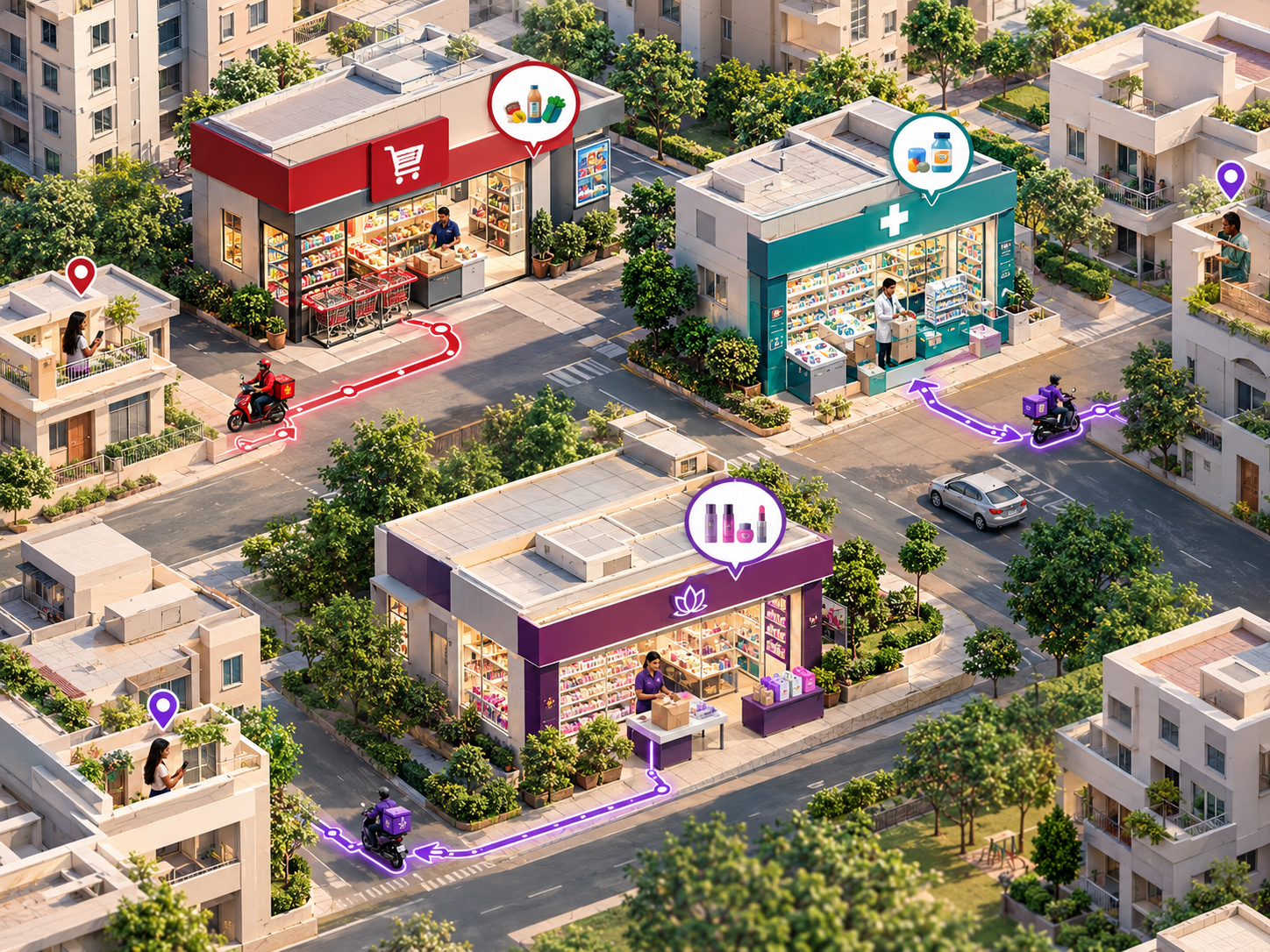
4. The operating workflow: from customer order to doorstep
A successful store-based model needs a coordinated sequence of actions.
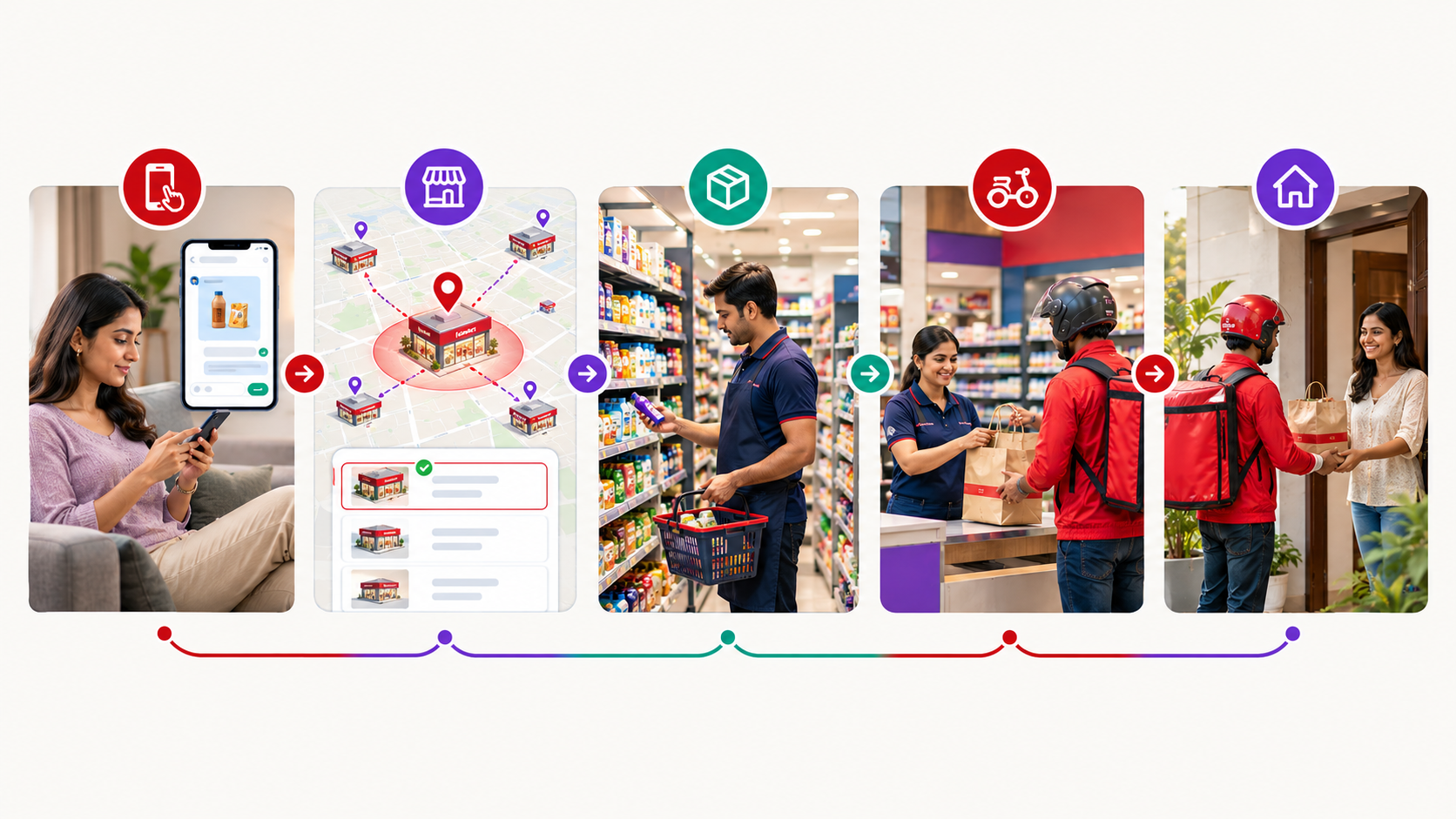
Step 1: Accept orders through a consistent channel
Customers should have a clear way to place orders, whether through the retailer's website, WhatsApp or another supported ordering channel.
Where orders are currently spread across personal phones and individual branches, centralising order visibility can be an important first step.
The objective is not necessarily to build a new customer app. It is to make sure the business can receive, track and fulfil orders reliably.
Step 2: Check availability and identify a suitable store
Use the customer's delivery location, product availability and store serviceability to identify a suitable fulfilment branch.
The nearest store may not always be the best choice. A slightly farther branch may have the complete basket available and enough capacity to fulfil it.
The routing process should account for the retailer's actual operating constraints rather than rely on distance alone.
Step 3: Send the order to the store team
The selected store needs an accessible order queue showing the requested items, customer details needed for fulfilment, and the current order status.
A staff member should be able to accept or flag the order and begin picking without having to search through unrelated messages.
Step 4: Pick, pack and confirm
The store team picks the items, checks them against the order and packs the basket for delivery.
If an item is unavailable, the team should follow a defined exception process. Depending on the system, this may involve proposing a substitution, seeking customer approval, reassigning the order or cancelling the affected item.
The goal is to avoid silently replacing products or promising stock that the store cannot supply.
Step 5: Dispatch and communicate
Once the order is ready, the retailer coordinates the handover to its chosen delivery resource.
Customers should receive accurate updates when their order is accepted, prepared, dispatched and delivered, where those status updates are supported.
Delivery assignments and status messages should reflect real operational events. An automated message must not imply that an order has been dispatched if the rider has not collected it.
Step 6: Record the outcome
The completed order should contribute to the retailer's operational records.
Central teams should be able to review order volumes, cancellations, stock discrepancies, delivery performance and repeat purchases across participating locations.
A direct ordering channel can also give the retailer more control over its customer relationship. That benefit depends on appropriate customer consent, data practices and compliance with applicable platform policies.
The result is a repeatable operating process—not merely a new way to receive messages.
5. What a three-store, six-week pilot could look like
A controlled pilot lets a retailer test the model before deciding whether to roll it out across the wider network.
The following is a proposed pilot structure, not a guaranteed implementation timeline. The actual schedule depends on the retailer's systems, stock data, delivery arrangements and store readiness.
| Timing | Activity | Primary owner |
|---|---|---|
| Week 0 | Select the store cluster, define the service area and agree on baseline metrics | Retailer operations and Shopap, if engaged |
| Week 1 | Select the initial catalogue, prepare store-level stock data, agree on delivery fees and minimum order value | Retailer operations |
| Week 1 | Configure the ordering workflow, store access and delivery handover process | Agreed implementation team |
| Week 2 | Test orders, train store teams and resolve workflow issues | Store managers and implementation team |
| Week 2 | Begin a controlled launch in the selected cluster | Retailer operations and marketing |
| Weeks 3–5 | Review results weekly and address the biggest causes of failure | Shared |
| Week 6 | Evaluate service quality, economics and operational workload; decide whether to expand, adjust or stop | Retailer leadership |
Why start with three stores?
A single store can test basic home delivery. A small group of nearby stores can also test the coordination challenges that appear in a multi-location operation.
For example, one branch may run out of a requested item while another has it available. The pilot can test how the business identifies that issue and resolves it without creating unnecessary delays or customer confusion.
Three stores are not automatically sufficient for every market. Choose a cluster that reflects the retailer's real delivery geography and has enough overlap to test the routing process.
What does the retailer need to contribute?
The pilot needs operational ownership, not just software.
The retailer should identify an accountable operations owner, ensure participating store managers follow the order process, provide sufficiently reliable stock data and establish a delivery arrangement.
A new customer app, full point-of-sale integration, dedicated warehouse or additional hires may not be necessary for every pilot. That must be determined during readiness assessment rather than promised in advance.
6. How should the pilot be measured?
Agree on success criteria before accepting live orders. Otherwise, the team may judge the pilot on impressions instead of results.
The table below gives an example scorecard. Any numerical targets are initial planning hypotheses, not industry benchmarks or guaranteed outcomes. Set the final targets according to the category, geography, margins and service promise.
| Metric | What to measure | Example target to evaluate |
|---|---|---|
| Orders per store per day | Completed delivery orders divided by live store-days | Eight or more by Week 6 |
| Average order value | Order value divided by completed orders | At or above the relevant baseline, where commercially realistic |
| Delivery time | Median time from order placement to doorstep within the defined service area | 45 minutes or less, if operationally achievable |
| Delivery success | Delivered orders divided by dispatched orders | 97% or more |
| Stock-out rate | Orders affected by unavailable items divided by orders | 10% or less |
| Repeat purchase rate | Customers placing two or more orders within 30 days | 30% or more, where the pilot duration and category support measurement |
| Store effort | Time spent picking, packing and handing over an order | Six minutes or less, if realistic for the category |
| Contribution per order | Revenue less the relevant variable costs of fulfilment | Positive after all relevant variable costs |
These targets should be treated as hypotheses to test. A pharmacy refill business, a fresh-food retailer and an electronics chain will not necessarily have the same acceptable delivery time, repeat rate or picking workload.
Also distinguish between metrics that can be measured immediately and those that require more time. A six-week pilot may not provide a mature view of repeat purchasing for every category.
The metric that matters most: contribution per order
Order volume alone does not establish that the business model works.
Consider an illustrative basket of ₹700 with a 20% gross margin.
- Basket value: ₹700
- Gross profit at 20%: ₹140
- Delivery cost: ₹50, assumed for this example
- Payment fees: ₹14, assumed for this example
- Messaging cost: ₹2, assumed for this example
That leaves ₹74 before picking and packing labour, packaging, discounts, refunds, platform fees and any other relevant costs.
The example is not a market benchmark. Actual fees depend on the payment method, delivery arrangement and service provider.
Do not call an order profitable until all relevant costs have been included. If contribution is negative at the typical basket size, the retailer may need to reconsider the minimum order value, delivery fee, product mix or fulfilment model.
7. When existing-store fulfilment is—and isn't—a good fit
This model deserves consideration when a retailer already has suitable locations, useful local inventory and the operational capacity to fulfil online orders.
It may be a poor fit, or require substantial changes, in the following situations.
Stores are too far apart. A dispersed network may not provide meaningful delivery coverage or a practical fallback when one store is out of stock. A single-store delivery model may be a better starting point.
Stock records are unreliable. If the business cannot establish what is available at each branch, it risks accepting orders it cannot fulfil. Start by improving stock visibility and limiting the online assortment.
Delivery costs exceed the basket economics. Low-value orders can be difficult to fulfil profitably. Minimum order values, delivery fees, bundles and assortment decisions may help, but the economics must be tested.
Store teams lack capacity. If online picking consistently disrupts walk-in sales, the business may need different staffing, a dedicated picking process or a different fulfilment location.
Customers expect delivery faster than the operation can support. Some products and occasions depend heavily on extremely short delivery windows. A store-based model should not promise a speed it cannot reliably achieve.
The retailer already has a mature digital operation. A chain with its own app, integrations and fulfilment infrastructure may need a more targeted solution, such as improved routing or additional channel integration, rather than a complete new ordering layer.
The decision should follow the operating evidence, not a blanket belief that existing stores are always better than dark stores.
8. How Shopap can help you launch store-based quick commerce
Your retail chain may already have the stores, products and local customer base needed to fulfil online orders. The challenge is connecting them into one coordinated operation.
Shopap helps businesses connect customer conversations and digital ordering workflows with the operations needed to act on them. For a multi-location retailer exploring quick commerce, the goal is to assess how customers can place orders, how those orders can be matched to suitable stores, and how fulfilment can fit into the existing business.
Rather than starting with a costly network expansion, start by understanding what your current stores can support.
Start with your existing store network
A practical assessment should answer four questions:
- Coverage: Which stores could serve nearby customers, and where do their service areas overlap?
- Inventory: Can the business identify which products are available at each participating store?
- Operations: Can store teams receive, prepare and hand over online orders without disrupting walk-in sales?
- Economics: Can delivery fees, basket size, margins and fulfilment costs support a commercially viable service?
The answers help determine whether to begin with a small pilot, address operational gaps first or consider a different fulfilment model.
Shopap's role is to explore how the ordering and fulfilment workflow can fit your existing setup. The implementation scope depends on your current systems, inventory data, delivery arrangements and integration requirements.
Could your stores support a local-delivery pilot?
Shopap may be worth exploring if you:
- Operate multiple retail locations in the same city or nearby neighbourhoods.
- Want to offer home delivery without immediately committing to dedicated dark stores.
- Receive customer enquiries or orders through WhatsApp, phone calls or other disconnected channels.
- Need a more coordinated way to connect customer orders with store-level inventory and fulfilment.
- Want to test the model in a limited number of locations before considering a wider rollout.
Let's assess your store network
Tell us where your stores are, how you currently manage inventory and how customers place orders. We can discuss whether an existing-store fulfilment pilot is a sensible next step and identify the operational questions to resolve before implementation.
Explore Shopap and get in touch at shopap.tech
Turn Your Existing Stores Into Local Fulfilment Hubs